

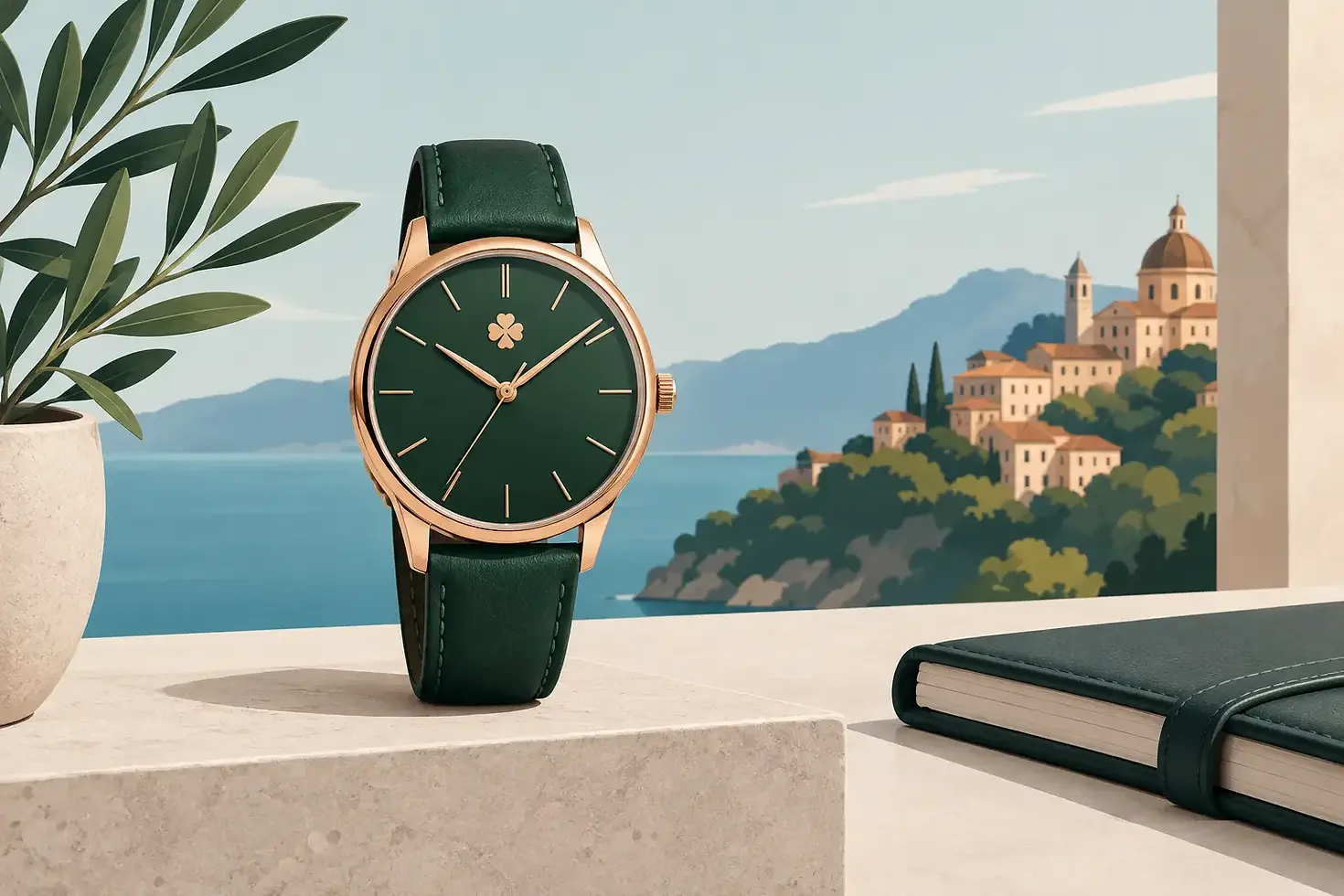
Italian Quartz Watch Review for Modern Collectors
A worthwhile Italian quartz watch review should begin with the dial, not the movement. Quartz is often treated as the practical choice - accurate, low-maintenance, ready when the day begins. But when the watch is Italian in spirit, practicality is only part of the point. The proportions, color, texture, typography, and small details around the case should earn a second look.
For the man who wears a watch as part of his presence, an Italian-designed quartz piece offers a compelling balance. It can carry the confidence of a considered object without asking for the rituals, cost, or occasional fragility of a mechanical watch. The right one feels intentional at a client meeting, at dinner, and in the quiet interval between the two.
What an Italian Quartz Watch Should Deliver
Italian design is not a guarantee of quality by itself. It is a point of view. The best examples favor visual clarity with a sense of drama: a case that feels architectural rather than merely round, a dial that uses negative space well, or a color choice that does more than imitate established luxury codes.
That distinction matters in a category crowded with generic watches. A basic quartz caliber can keep excellent time in almost any case. What separates a memorable watch from a forgettable one is how the design turns that dependable movement into something with character.
Look closely at the relationship between the dial and case. A wide dial with thin indices can feel precise and metropolitan. Applied markers add depth when they are placed with restraint. A contrasting seconds hand can bring energy to a minimal face, while a layered dial can make a larger watch feel more deliberate. None of these choices need to be loud. They simply need to have a reason for being there.
Italian quartz watches are particularly strong when they resist the urge to mimic a Swiss classic. A familiar silhouette has its place, but an expressive watch should offer its own identity. That may mean an unexpected case profile, an open-work detail, a sculptural crown, or a dial that invites conversation without demanding it.
Italian Quartz Watch Review: Precision Meets Presence
The functional case for quartz remains persuasive. A quality quartz movement is highly accurate, typically needs only a battery change every few years, and handles the irregular rhythms of ownership well. Leave it in a drawer for a week, pick it up before a flight, and it is still ready. For professionals who rotate watches or travel often, that convenience is not a minor advantage.
Quartz also allows design to take center stage. Without the thickness and cost structure often associated with mechanical movements, designers can explore slimmer cases, more ambitious dial construction, and expressive materials at a more approachable price. In the $295 to $750 range, this can translate into a watch that feels visually elevated rather than compromised.
The trade-off is emotional rather than practical. A mechanical movement offers a visible tradition of gears, springs, and hand-finishing that many collectors enjoy. Its appeal is tactile and historical. Quartz is quieter in that sense. It does not ask to be admired through an exhibition case; it asks to be worn without friction.
Neither approach is inherently superior. If you collect watches for mechanical complexity, a quartz watch may feel like a departure. If you care most about design, reliability, and the ease of wearing something distinctive every day, quartz can be exactly the right decision. The stronger question is not whether quartz is prestigious enough. It is whether the watch gives you a reason to put it on.
Design Details That Matter More Than Spec Sheets
A spec sheet rarely communicates how a watch actually wears. Dimensions help, but the experience depends on proportion. A 42 mm case can feel refined when its lugs curve closely to the wrist and its bezel is slim. A smaller case can still command attention if the dial has depth and confidence.
Finish is equally revealing. Brushed surfaces tend to feel purposeful and understated, while polished edges catch light and sharpen a dressier look. The best cases use both with discipline. When every surface is bright, the watch can become visually flat. When the finishing is balanced, the watch changes character as the wrist moves.
Then there is the strap. Leather lends warmth and formality, especially in espresso, black, or deep navy. A steel bracelet creates a more assertive, versatile profile. Textured rubber can make a graphic watch feel contemporary rather than sporty by default. Pay attention to the strap width and the way it meets the case. A well-integrated strap makes the whole design feel resolved.
Crystal choice deserves consideration, too. Sapphire is valued for scratch resistance and is a sensible feature for a watch intended for frequent wear. Mineral crystal can be perfectly serviceable, but it may show its life sooner. That is not always a dealbreaker, particularly when the design and price are right, but it is a meaningful distinction for a long-term purchase.
Choosing the Right Style for Your Wardrobe
The most successful watch is not necessarily the one that works with everything. It is the one that makes your existing wardrobe feel more considered. If your style leans tailored - navy jackets, crisp shirts, dark denim, loafers - a clean silver, black, or deep blue dial offers range without fading into the background.
For men who dress with more contrast, a watch with a warm-toned dial, bold numerals, or unusual case geometry can become a signature. It works especially well when the rest of the outfit stays controlled. One distinctive object has more impact than several competing ones.
A few questions can clarify the choice:
Do you want a watch that disappears under a cuff, or one that starts a conversation?
Will you wear it mainly with tailoring, casual layers, or both?
Does the dial still interest you after the first impression fades?
Can you imagine reaching for it on an ordinary Tuesday, not just for an occasion?
That last question is often the best test. A watch should have enough personality to feel special, yet enough ease to become part of your routine.
Where Value Really Lives
At accessible premium prices, value is not about chasing the longest feature list. It is about coherence. A watch earns its place when the case, dial, hands, strap, packaging, and overall presentation feel like parts of the same idea.
This is where design-led brands can be particularly persuasive. Collections such as Millimetro, Veloce, Philosopher, Spax-Jeyo, M8, Setteventi, and Voyager approach the wrist from different visual directions rather than repeating one generic formula. That range lets a buyer choose a personality, not just a dial color. Trifoglio Italia understands that distinction: a watch can be precise enough for daily life while still carrying an artistic point of view.
There are limits to keep in mind. At this price level, do not expect the finishing vocabulary or movement pedigree of a five-figure Swiss piece. That is not the proposition. The appeal is thoughtful Italian design, dependable quartz performance, and a more individual expression than the usual mass-market watch delivers.
A considered quartz watch does not need to announce itself with complications or a familiar logo. Its confidence comes from proportion, detail, and the feeling that someone designed it with a point of view. Choose the one that continues to hold your attention after the first glance. That is usually the watch that becomes yours.


Comments